
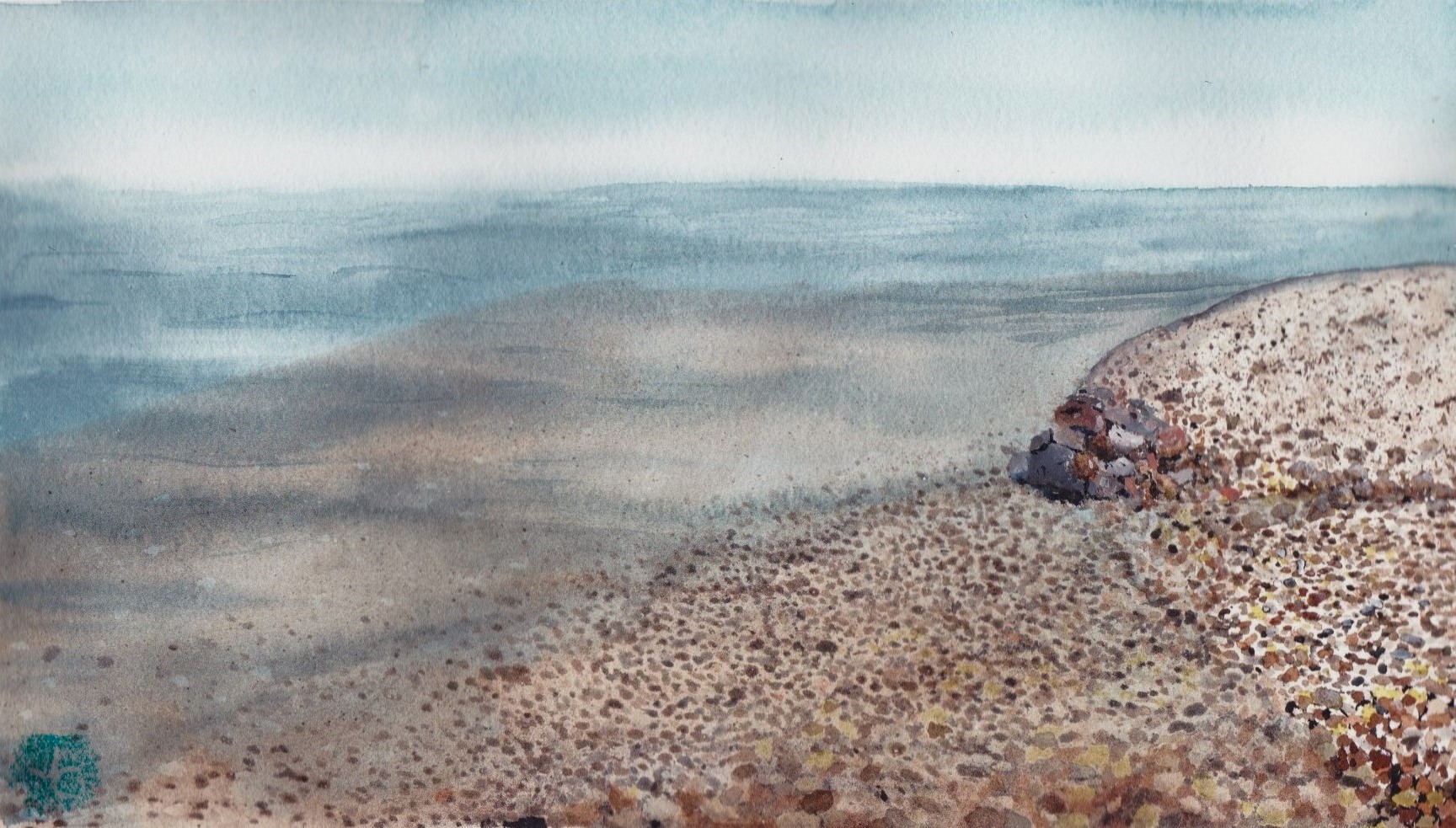
I have learned that if you must leave a place that you have lived in and loved and where all your yesteryears are buried deep, leave it any way except a slow way, leave it the fastest way you can. Never turn back and never believe that an hour you remember is a better hour because it is dead. Passed years seem safe ones, vanquished ones, while the future lives in a cloud, formidable from a distance. The cloud clears as you enter it. I have learned this, but like everyone, I learned it late. ~ Beryl Markham (West with the Night)
I read Beryl Markham’s inspiring autobiography, West with the Night, when I was in my 20s. It is still one of my favorite books. As I get older, different things come forward, like the strong directive quoted here which popped right out at me this time.
It is relatively easy to barge into the future when you are young, as I was when I probably skimmed over this paragraph in my 20s. Maybe the memories you have at the time are filled with things you are anxious to let go of, like dependency, school-age insecurities, and struggles with your parents who still loom large over every choice you make. Moving forward is so exciting that perhaps you don’t even need courage.
But the memories I have at my current age are different. They are of good years, work I am proud of, relationships I tended imperfectly but with great care, experiences I cherished at the time and that will never come again: My first apartment, finishing grad school, becoming competent at work, falling in love, watching my two sons step up to bat in little league . . . the list is like a long chain of pearls that I don’t want to put away. I want to wear them every day for the whole world to see. Even the hard times don’t seem so hard in retrospect. A lot of personal growth came from those times, even when they were messy, even when they left me rolling my eyes at myself. I want it all (mostly).
I am also, constitutionally, someone who does not let go easily. Markham speaks of leaving a place ‘where all your yesteryears are buried deep,’ and I am lucky to have had places like that. For example, in preparation for my retirement, I spent at least three years shedding tears grieving my career before I cut the cord. How much more grief I spend on my parents and grandparents, friends who have passed away, the cottage we spent our summer vacations at, music recitals, … I simply cannot measure. Let’s estimate it at ‘LOTS.’
Still, Markham says ‘Run! Don’t walk!’ Turn your back hard on these beautiful things, and move on.
Her point is that the past is known to us and so can become a safe refuge when we face cloudy uncertainty. But the past is not safe. Those years are gone and we cannot be alive if we live in them.
For sure, our older years are nothing if not uncertain. We don’t even know if we will have them, much less if we will be able to enjoy them. As an airplane pilot, Markham learned the clouds will clear and that we will know (or learn) how to live in the new places we find.
What a comfort her perspective is.
Making the shift to now
But we have to let go of the past first. May Sarton wrote an autobiography every decade once she turned fifty-something. The first one is my favorite (Plant Dreaming Deep). In it, she transitions into a new home in New Hampshire some years after her parents have died. She finds a new house to buy and sorts through all the things of her past to decide what will come with her and where it will fit in her new home. She has one foot in her past and another in her future. The reader simply observes her struggle to let go, to reclaim things of value on her own terms, and to create her new life. She feels the stickiness of these items and all her memories and she confronts them, one at a time, either choosing to shed them or bring them into her life in a fresh way.
Many of us know this transition well. For me, it happened in small ways as each of my older relatives passed away and items from their homes found their way into our living room (and basement). When my husband and I moved to our cottage in Michigan, we sifted through all of those items and decided what would have a future with us: What were we carrying that no longer served us? What would we repeatedly trip over? What would support us and bring us joy?
The sifting of family hand-me-downs, regardless of their value, is the concrete manifestation of what Markham points to, of letting go, of not letting the past stick to us too much. Maybe she would advise us to get rid of everything. In my case, we did not. Like Sarton, what we kept we brought with us on our own terms. And like Sarton, these items would be part of a future we could only see in a cloudy way.
Living in the clouds
Three years later, the future is still cloudy. Perhaps this is the hardest reality of getting older. The clouds lift for just a few months at a time. And our job is just to pilot our way forward, to adapt to whatever happens when the clouds clear and to make progress when we can (whatever that means for each of us). A number of my friends who have gone through the dying process shift to shorter and shorter windows of clarity.
But I wonder what freedoms surface when we wade our way from one cloudy patch to the next. What new growth might become possible? This is the question I am living with now.
I don’t have an answer. But here my memory is a little helpful. I remember other times when my future seemed cloudy and frightful. On the night before my first class in graduate school, I had a nightmare in which the book I needed to read was written in Spanish and my professor lectured in German. I could not read or write Spanish or German, and went into a panic. Even so (and this is the funniest part of the dream to me), in my nightmare, I said to myself, ‘OK. Somehow, I will figure this out.’
So, first, my memories can remind me I have experienced uncertainty before and those periods have prepared me for the emotional work of dancing with it now.
Second, there is no hurry. Nothing except my own happiness is waiting on me to sort this out. Some days will seem clearer than other days. If I can be soft with that awareness, rather than demanding clarity every day, I can take my time to learn whatever is there to learn. Patience can keep my mind open.
Finally, there was a book we used to read to our kids when they were little. I think about it a lot. It was about a snail who wanted a much larger and prettier shell. But when he got it, he could no longer move around easily. He was stuck and so he could not have as much fun as he did before, or deal with rain or wind as easily. He realized the wisdom of having a small, easily mobile shell. Life was more fun. He was more resilient.
So as I pilot these cloudy years, I try to go lightly, both emotionally and physically. I try to question my attachments to see if they make me more resilient or less, make me more ready to take advantage of a stretch of clear skies or less.
For now, this approach is helpful. What I learn is yet to be seen.